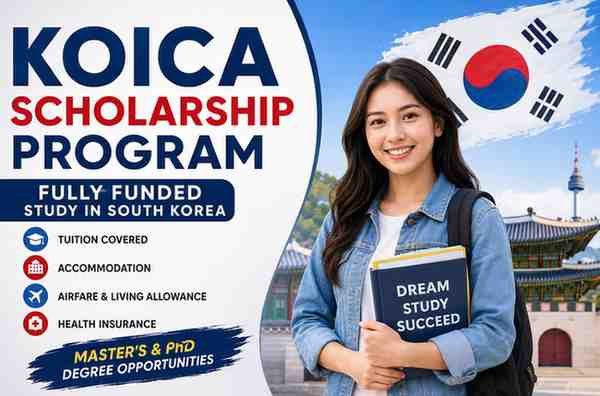
KOICA Scholarship Program: Fully Funded Scholarship in South Korea for International Students (2027 Guide)
If you’re searching for a fully funded scholarship that covers tuition, accommodation, living expenses, and airfare, the KOICA Scholarship Program is one of the most valuable opportunities available. Sponsored by the Korea International Cooperation Agency (KOICA), this prestigious scholarship helps talented professionals from developing countries pursue postgraduate education at some of South Korea’s leading universities.
Beyond earning a globally recognised degree, recipients gain access to advanced research facilities, international networking opportunities, leadership development programmes, and practical skills that can contribute to their careers back home. The scholarship is designed to strengthen global cooperation while preparing future leaders in public administration, engineering, healthcare, education, technology, environmental management, and many other fields.
For students and professionals planning their international education journey, understanding scholarship requirements early can make the application process much smoother. Many applicants also explore topics such as the student visa application process, visa sponsorship for international students, study permits, international student health insurance, and education financing options while preparing for overseas study.
This comprehensive guide explains everything you need to know about the KOICA Scholarship Programme, including eligibility requirements, financial benefits, available degree programmes, application procedures, visa guidance, career opportunities after graduation, and practical advice for prospective applicants.
What Is the KOICA Scholarship Program?
The KOICA Scholarship Program is a fully funded postgraduate scholarship initiative established by the Korea International Cooperation Agency. The programme supports government officials and employees of public institutions from partner countries who wish to pursue master’s or doctoral degrees in South Korea.
The primary goal is to strengthen human resource development by providing high-quality education and specialised professional training. Graduates return to their home countries equipped with advanced knowledge, international experience, and practical skills that contribute to national development.
Unlike many scholarships that simply provide financial assistance, KOICA combines academic study with leadership training, cultural exchange, professional networking, and policy-focused education. Participants study at carefully selected Korean universities known for academic excellence and innovation.
Quick Overview of the KOICA Scholarship Program
| Feature | Details |
|---|---|
| Scholarship Type | Fully Funded |
| Host Country | South Korea |
| Degree Levels | Master’s and PhD |
| Funding Organization | Korea International Cooperation Agency (KOICA) |
| Language | Primarily English |
| Eligible Applicants | Government officials and employees of public institutions from partner countries |
| Application Cost | No tuition cost for selected scholars |
Why Choose South Korea for Higher Education?
South Korea has become one of Asia’s leading destinations for international students. Universities consistently rank among the world’s best for engineering, information technology, artificial intelligence, business, healthcare, and public policy.
Students benefit from modern laboratories, advanced research centres, digital classrooms, and strong collaboration between universities and industry. This learning environment provides practical skills that employers value around the world.
South Korea is also recognised for its safe cities, efficient public transportation, affordable healthcare, and vibrant culture. International students enjoy a high quality of life while studying in one of the world’s most technologically advanced countries.
Many graduates later explore opportunities related to a post-study work visa, work permit after study, or professional experience with multinational organisations before returning home or pursuing international careers.
Benefits of the KOICA Scholarship Program
One reason the KOICA Scholarship Programme attracts thousands of applicants each year is its comprehensive financial support. The scholarship removes many of the financial barriers associated with studying abroad.
Full Tuition Coverage
All approved tuition costs are paid directly to the university. Students do not need to worry about annual tuition increases or semester fees covered under the scholarship agreement.
Monthly Living Allowance
Recipients receive a monthly stipend that helps cover food, transportation, communication expenses, and daily living costs throughout the study period.
Round-Trip Airfare
The scholarship normally includes economy-class airfare between the recipient’s home country and South Korea at the beginning and completion of the programme.
Accommodation Support
Most scholars stay in university dormitories or designated housing arranged through participating institutions, reducing the stress of finding suitable accommodation after arrival.
Students researching student accommodation in South Korea often find university housing to be both affordable and conveniently located near campus facilities.
Medical Coverage
The scholarship includes health insurance support, helping scholars access quality healthcare during their studies. Having international student health insurance provides peace of mind throughout the academic journey.
Settlement Allowance
Many recipients receive an initial settlement allowance to help cover essential expenses after arriving in South Korea, including transportation, supplies, and personal necessities.
What Expenses Does the Scholarship Cover?
| Expense | Coverage |
|---|---|
| Tuition Fees | Fully Covered |
| Monthly Living Allowance | Covered |
| Accommodation | Provided or Supported |
| Round-Trip Airfare | Included |
| Medical Insurance | Included |
| Settlement Allowance | Included |
Available Degree Programs
Each year, participating Korean universities offer specialised graduate programmes that address global development priorities.
Popular areas of study include:
- Public Administration
- Public Policy
- Artificial Intelligence
- Computer Science
- Information Technology
- Civil Engineering
- Environmental Engineering
- Agriculture
- Public Health
- Education
- Economics
- Climate Change
- Urban Development
- Transportation Management
- International Development
Programmes are delivered by respected universities that combine academic research with practical learning experiences, ensuring graduates are well prepared for leadership positions.
Who Can Apply?
The KOICA Scholarship Program is not an open scholarship for every international student. It primarily targets professionals working in government ministries, public agencies, and public-sector organisations within eligible partner countries.
Applicants are generally expected to have relevant work experience, a strong academic background, and support from their employer or nominating authority. This makes the scholarship highly competitive but also highly respected among employers.
Because admission standards vary by university and programme, candidates should carefully review academic requirements before submitting an application.
Why Is the KOICA Scholarship Highly Competitive?
Thousands of qualified professionals compete for a limited number of scholarship positions every year. Successful applicants typically demonstrate academic excellence, leadership potential, professional achievements, and a clear commitment to contributing to national development after graduation.
A well-prepared application with strong recommendation letters, a compelling study plan, and relevant work experience significantly improves the chances of selection.
Continue to Part 2, where we’ll cover the complete eligibility requirements, required documents, application process, visa guidance, budgeting tips, accommodation, and practical advice for submitting a competitive KOICA scholarship application.
KOICA Scholarship Program Eligibility Requirements
Meeting the eligibility requirements is the first step toward submitting a competitive application. Because the KOICA Scholarship Programme is designed for capacity building and international development, the selection criteria differ from many traditional university scholarships.
Applicants are generally expected to demonstrate academic ability, professional experience, leadership potential, and a commitment to contributing to the development of their home country after completing their studies.
General Eligibility Criteria
While individual programmes may have additional requirements, applicants are typically expected to meet the following conditions:
- Be a citizen of a KOICA partner country.
- Be nominated by the designated government authority or relevant organisation.
- Work in a government ministry, public institution, or government-affiliated organisation.
- Hold the required academic qualification for the selected degree programme.
- Have a strong academic record.
- Meet the English language requirements specified by the university.
- Be in good physical and mental health.
- Demonstrate leadership potential and a commitment to public service.
Some universities may also require a minimum number of years of professional experience before applicants become eligible for admission.
Who Has the Best Chance of Being Selected?
Selection committees evaluate more than academic transcripts. They look for candidates who have already demonstrated responsibility within their organisations and who are likely to apply their new knowledge to public development projects.
Strong applicants often have:
- Relevant work experience
- Leadership responsibilities
- Excellent academic performance
- Clear career objectives
- A well-written study plan
- Professional recommendation letters
- Strong communication skills
The scholarship is highly competitive, so presenting a clear vision for your future career can significantly strengthen your application.
Academic Requirements
Applicants should possess the appropriate educational qualification before applying.
| Program | Minimum Qualification |
|---|---|
| Master’s Degree | Bachelor’s Degree |
| PhD Degree | Master’s Degree |
Academic transcripts should accurately reflect previous studies and may need to be translated into English if originally issued in another language.
English Language Requirements
Most KOICA programmes are delivered in English, making strong communication skills essential.
Some universities request proof of English proficiency, while others assess applicants during interviews or through the application review process.
If your university requires standardised language test results, preparing early can improve your overall application profile.
Required Documents Checklist
Preparing documents several weeks before the deadline helps prevent unnecessary delays.
| Document | Required |
|---|---|
| Completed Application Form | Yes |
| Passport Copy | Yes |
| Degree Certificate | Yes |
| Academic Transcript | Yes |
| Recommendation Letters | Usually Required |
| Statement of Purpose | Yes |
| Employment Certificate | Yes |
| Medical Examination | If Requested |
| Passport Photos | Yes |
How to Apply for the KOICA Scholarship Program
Step 1: Review Available Programs
Visit the official KOICA scholarship announcement and review the participating universities, degree programmes, eligibility criteria, and application timeline.
Step 2: Obtain Government Nomination
Applicants usually submit their applications through the designated government agency, ministry, or KOICA office responsible for nominations in their country.
Step 3: Prepare Supporting Documents
Ensure every document is complete, accurate, and submitted before the application deadline. Missing paperwork is one of the most common reasons applications are rejected.
Step 4: University Evaluation
Shortlisted applicants may be invited for interviews or additional assessments conducted by the participating university.
Step 5: Final Selection
Successful candidates receive admission confirmation together with scholarship approval and pre-departure guidance.
Selection Process
The evaluation process is thorough and may include document screening, academic assessment, interviews, and verification by KOICA and the host university.
Selection committees consider the following:
- Academic achievement
- Professional experience
- Leadership qualities
- Career goals
- Public service commitment
- Potential contribution to national development
Student Visa Application Process
After receiving the scholarship award and university admission, applicants begin the student visa application process for South Korea.
The university and KOICA normally provide the documents required to support the visa application.
Applicants should submit their visa applications as early as possible to avoid delays before departure.
Common Visa Documents
- Valid passport
- Admission letter
- Scholarship confirmation
- Completed visa application form
- Passport photographs
- Medical documents (if required)
- Additional embassy requirements
Since the scholarship covers major educational expenses, recipients usually have a straightforward process when demonstrating financial support during visa applications.
Visa Sponsorship for International Students
The KOICA Scholarship Program effectively provides financial sponsorship that supports your studies in South Korea. This greatly reduces concerns about tuition fees, accommodation, and monthly living expenses.
Many students researching visa sponsorship for international students consider fully funded scholarships like KOICA among the strongest pathways for overseas education.
Accommodation and Living Arrangements
Most scholars stay in university dormitories during their studies. Campus housing offers a convenient and affordable option while helping international students adapt to life in South Korea.
Students benefit from furnished rooms, internet access, shared facilities, libraries, cafeterias, and easy access to classrooms.
Those considering private housing should compare rental costs before signing contracts.
Estimated Monthly Budget
| Expense | Usually Covered |
|---|---|
| Accommodation | Yes |
| Food | Living Allowance |
| Transportation | Living Allowance |
| Books and Supplies | Partially Covered |
| Health Insurance | Covered |
International Student Health Insurance
Healthcare protection is an essential part of studying abroad. The scholarship includes health insurance support, allowing students to receive medical care while living in South Korea.
Understanding your insurance coverage before arrival helps you access healthcare services quickly whenever needed.
Helpful Tips for a Strong Application
- Start preparing several months before the deadline.
- Write a personalised statement of purpose.
- Request recommendation letters early.
- Proofread every document carefully.
- Highlight measurable professional achievements.
- Demonstrate leadership experience.
- Explain how your education will benefit your country.
- Follow every application instruction carefully.
A complete, organised, and well-presented application reflects professionalism and improves your chances of progressing through the selection process.
Continue to Part 3, where we’ll cover post-study work opportunities, work permits after study, permanent residence pathways, career prospects, immigration-related guidance, official resources, frequently asked questions, and the article conclusion.
Career Opportunities After Completing the KOICA Scholarship Program
Earning a postgraduate degree through the KOICA Scholarship Program can significantly strengthen your professional profile. Graduates often return to leadership positions within government ministries, public institutions, international organisations, universities, and development agencies.
The programme is specifically designed to build capacity in partner countries. As a result, many alumni take on roles where they can influence public policy, improve public services, lead infrastructure projects, strengthen healthcare systems, or contribute to educational reform.
Employers value graduates who have gained international exposure, cross-cultural communication skills, and advanced technical knowledge from South Korea’s highly respected universities.
Industries That Frequently Employ KOICA Graduates
- Public Administration
- Government Ministries
- International Development Organizations
- Public Health Agencies
- Engineering and Infrastructure
- Environmental Protection
- Agriculture and Food Security
- Digital Government
- Information Technology
- Higher Education Institutions
Can You Work While Studying in South Korea?
International students in South Korea may be permitted to work part-time under specific immigration rules. However, scholarship recipients should always follow the conditions of their scholarship agreement and visa.
Universities usually provide guidance regarding part-time employment, permitted working hours, and the approvals required before accepting any job.
Students should prioritise their academic responsibilities, as maintaining satisfactory academic performance is essential for retaining scholarship benefits.
Work Permit After Study
Many graduates are interested in obtaining a work permit after study. South Korea offers several immigration pathways that may allow qualified graduates to remain in the country for employment, depending on current immigration regulations and individual circumstances.
Graduates who secure employment with eligible employers may qualify for an appropriate work visa. Requirements vary according to occupation, employer sponsorship, and immigration policies in effect at the time of application.
Those considering long-term employment should begin researching opportunities before graduation and make use of university career services.
Post-Study Work Visa Options
A post-study work visa allows eligible graduates to remain in South Korea while seeking employment or transitioning into a professional work visa.
Immigration rules can change over time, so applicants should always confirm the latest requirements through official immigration authorities before making career decisions.
Networking with professors, internship supervisors, and employers during your studies can improve your chances of securing employment after graduation.
Permanent Residence Opportunities
Some international graduates eventually become eligible to apply for long-term residence after meeting employment, residency, and immigration requirements.
Applicants interested in a permanent residence application should understand that eligibility depends on factors such as visa history, employment, income, and government regulations.
While some graduates choose to pursue opportunities abroad, many KOICA scholars return to their home countries to apply their newly acquired knowledge in public service and national development.
Scholarship vs. Self-Funded Study
| Feature | KOICA Scholarship | Self-Funded Study |
|---|---|---|
| Tuition Fees | Fully Covered | Student Pays |
| Accommodation Support | Usually Provided | Student Arranges |
| Monthly Living Allowance | Included | Self-Funded |
| Airfare | Included | Self-Funded |
| Medical Insurance | Included | Usually Purchased Separately |
Education Financing Options
Although the KOICA Scholarship covers most educational expenses, applicants who are not selected often explore other funding sources.
Common alternatives include:
- University scholarships
- Government grants
- Employer sponsorship
- Education loan without collateral
- Private education financing options
- Financial aid for international students
Comparing multiple funding opportunities can help students identify the most suitable pathway to study abroad.
Should You Hire an Education Consultant?
Many applicants successfully complete their applications independently using official guidelines. Others prefer working with a qualified university admission consultant or education consultant for South Korea for assistance with document preparation and application review.
If you choose professional assistance, verify the consultant’s experience, reputation, and transparency before paying any fees.
Students searching online for a study abroad consultant near me or an international student recruitment agency should compare services carefully and rely on official scholarship information whenever possible.
Immigration and Visa Considerations
Scholarship recipients occasionally seek legal guidance regarding immigration matters, employment, or long-term residence. Depending on your situation, consulting a qualified immigration lawyer in South Korea or obtaining an immigration attorney consultation may be helpful for complex legal questions.
If you plan to pursue employment after graduation, understanding visa requirements early can help you prepare for a smooth transition.
Applicants considering careers in countries such as the United Kingdom or the United States after graduation should review the relevant immigration rules before making long-term plans.
Practical Tips for Future Applicants
- Research universities before choosing a programme.
- Prepare all documents well in advance.
- Write a clear and realistic study plan.
- Demonstrate leadership through professional achievements.
- Proofread every document before submission.
- Meet every deadline.
- Follow instructions exactly as published.
- Practice for scholarship interviews.
- Stay updated through official announcements.
- Never submit inaccurate or misleading information.
Frequently Asked Questions (FAQs)
1. Is the KOICA Scholarship fully funded?
Yes. It generally covers tuition fees, monthly living expenses, accommodation support, airfare, and health insurance for selected scholars.
2. Can international students apply?
The scholarship is available to applicants from eligible KOICA partner countries who meet the programme’s eligibility requirements.
3. Is IELTS required?
Requirements vary by university and programme. Some institutions may require proof of English proficiency, while others assess applicants through interviews or alternative methods.
4. Can private-sector employees apply?
The scholarship primarily targets government officials and employees of public-sector institutions. Applicants should review the eligibility requirements for the specific programme they intend to apply for.
5. Does the scholarship pay for accommodation?
Yes. Most scholars receive university housing or accommodation support as part of the scholarship package.
6. Can I work during my studies?
Part-time work may be possible under South Korean immigration regulations and scholarship conditions. Always confirm current rules with your university and immigration authorities.
7. How competitive is the KOICA Scholarship?
It is highly competitive because it attracts qualified professionals from many partner countries each year.
8. Are family members allowed to accompany scholarship recipients?
Policies vary depending on the scholarship conditions, visa regulations, and personal circumstances. Applicants should review the latest official guidance before making arrangements.
9. Can graduates remain in South Korea after completing their degree?
Some graduates may qualify for employment-related visas or other immigration pathways if they meet the applicable legal requirements.
10. Where can I find official application information?
Applicants should always rely on official KOICA announcements, participating universities, and the Korean embassy or KOICA office in their country.
Official Sources
| Organization Name | Purpose | Official Website |
|---|---|---|
| Korea International Cooperation Agency (KOICA) | Scholarship information and program announcements | https://www.koica.go.kr |
| Study in Korea | Official higher education information for international students | https://www.studyinkorea.go.kr |
| Ministry of Justice, Republic of Korea | Immigration and visa information | https://www.immigration.go.kr |
| Korean Embassies | Visa applications and country-specific guidance | https://www.mofa.go.kr |
Final Thoughts
The KOICA Scholarship Program is one of the most prestigious fully funded opportunities for professionals seeking postgraduate education in South Korea. With comprehensive financial support, access to world-class universities, and a strong focus on leadership and public service, it offers far more than a degree—it provides an opportunity to build expertise, expand international networks, and contribute meaningfully to your home country.
Success begins with careful preparation. Review the eligibility requirements, gather your documents early, write a compelling statement of purpose, and rely on official sources throughout the application process. A thoughtful, well-organised application can significantly improve your chances of joining the next group of KOICA scholars.