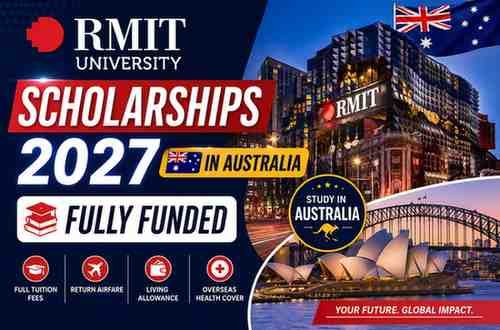
RMIT University Scholarships 2027 in Australia (Fully Funded)
If you have spent any time comparing Australian universities for a fully funded master’s or PhD, RMIT probably came up more than once. It sits in Melbourne, has strong industry ties in engineering, design, business, and technology, and runs one of the more generous scholarship portfolios among Australian universities open to international students.
This guide breaks down what RMIT is actually offering for the 2027 intake, who qualifies, how the application and visa process fits together, and what happens after graduation if you want to stay and work in Australia. Treat it as the conversation a scholarship advisor would have with you before you start filling out any forms.
What RMIT Scholarships Actually Cover
RMIT University, formally the Royal Melbourne Institute of Technology, offers several scholarship categories rather than one single “RMIT Scholarship”. Understanding which category fits your situation matters more than the university’s overall reputation.
The most relevant fully funded options for international students are the RMIT Global Excellence Scholarship, RMIT Vice-Chancellor’s Scholarships for higher degrees by research candidates, and the Destination Australia scholarship, which is government-funded but delivered through participating universities, including RMIT’s regional campuses.
“Fully funded” in the Australian context usually means tuition fee coverage plus a living stipend, and sometimes travel and health insurance. Not every RMIT scholarship covers all of these, so checking exactly what a specific award includes before you build your budget around it is essential.
It also helps to understand how RMIT structures its funding compared to some other Australian universities. Rather than one flagship international scholarship, RMIT spreads funding across faculty-level awards, university-wide merit scholarships, and government-partnered programmes like Destination Australia. This means a student who misses out on the university’s headline scholarship might still qualify for a faculty-specific award that covers just as much, simply because fewer applicants know to look for it.
Why RMIT Stands Out Among Australian Universities
Melbourne is consistently ranked among the world’s most liveable cities, and that matters more than people expect when you are relocating for two or more years. A university’s reputation only carries you so far if daily life in the city feels difficult.
RMIT also runs one of Australia’s strongest applied learning models, with direct industry placements built into many programmes. For students weighing career and job opportunity outcomes after graduation, that practical exposure often translates into stronger employability than a purely theoretical degree.
Strong industry partnerships. RMIT has long-standing relationships with companies across design, engineering, IT, and construction, which regularly feed into student placements and graduate hiring pipelines.
A large, established international student community. RMIT hosts one of the largest international student populations of any Australian university, which means dedicated support services, from academic advising to relocation services for students, are genuinely well resourced rather than an afterthought.
Financial predictability. A fully funded scholarship removes the uncertainty of currency fluctuations and rising tuition, which matters enormously for students who would otherwise need an education loan without collateral to study abroad.
A realistic post-study pathway. Australia’s post-study work visa system is one of the more accessible in the world for STEM and design graduates, something we will unpack later in this guide.
There is also a less obvious advantage worth mentioning: RMIT’s campus network. Beyond the main Melbourne city campus, RMIT operates regional campuses and international partner campuses, which occasionally opens up scholarship categories, like Destination Australia, that are not available to students applying to purely metropolitan universities.
How RMIT Compares to Other Australian Scholarship Routes
Prospective students often weigh RMIT against other Australian universities offering similar international scholarships, such as the University of Melbourne’s Graduate Research Scholarships or Deakin’s international awards. Here is a general sense of how these routes differ.
| Scholarship Route | Typical Strength | Best Suited For |
|---|---|---|
| RMIT Global Excellence Scholarship | Strong industry-linked coursework programmes | Applied fields like design, engineering, IT, business |
| University-wide research scholarships (other institutions) | Deeper research funding pools | PhD candidates prioritising pure research output |
| Destination Australia Scholarship | Regional cost-of-living advantage | Students open to studying outside major cities |
None of these routes is universally better. The right choice depends on whether you value RMIT’s applied, industry-connected teaching style or a more traditional research-heavy environment elsewhere.
Cost of living also plays into this comparison more than people initially factor in. Melbourne sits at a mid-to-upper range among Australian capital cities for rent and daily expenses, generally more affordable than Sydney but comparable to Brisbane. For students choosing between a fully funded RMIT scholarship and a partially funded offer from a university in a pricier city, the total two-year cost difference can be substantial once accommodation and everyday spending are factored in alongside tuition.
Detailed Overview of the 2027 Scholarship Options
Scholarship names, values, and eligibility criteria are reviewed annually by RMIT, so always cross-check the live figures on RMIT’s official scholarships page before applying. That said, here is how the main categories generally compare heading into the 2027 intake.
| Scholarship | Level | Typical Coverage | Best Suited For |
|---|---|---|---|
| RMIT Global Excellence Scholarship | Undergraduate & Postgraduate coursework | Partial to full tuition fee reduction | High-achieving international applicants |
| RMIT Vice-Chancellor’s Scholarship (HDR) | PhD / Research Masters | Tuition, stipend, health cover | Research-focused candidates with a strong publication or project record |
| Destination Australia Scholarship | Undergraduate & Postgraduate | Annual grant toward tuition and living costs | Students enrolling at RMIT’s regional Australian campuses |
Postgraduate coursework students should note that the Global Excellence Scholarship is competitive and merit-based, meaning admission alone does not guarantee an award. Research students applying through the Vice-Chancellor’s Scholarship route generally need a confirmed supervisor and project outline before their application is considered complete.
Who Should Consider Applying
You do not need a flawless academic record to be competitive, but you do need a clear, specific reason for choosing RMIT over other Australian universities offering similar programmes.
Students from an engineering, design, IT, or business background tend to have the widest range of eligible programmes at RMIT, though the university also runs strong scholarship-supported pathways in health sciences and built environment courses.
If you are coming from a smaller undergraduate institution without a well-known international reputation, do not assume that counts against you. RMIT’s admissions and scholarship committees generally weigh your actual coursework, grades, and project work more heavily than institutional prestige.
Career changers and students returning to study after a few years in the workforce are also well represented at RMIT, particularly in its postgraduate business and technology programmes. Relevant work experience, especially if it connects clearly to your intended course, can strengthen a scholarship application just as much as academic results.
If you are unsure whether your background fits, RMIT’s international admissions team and its network of authorised education agents can usually give a realistic read on your chances before you commit time to a full application.
Eligibility Requirements and Selection Criteria
Requirements differ slightly by scholarship category, but most RMIT international scholarships share a common eligibility baseline.
Academic performance. A strong GPA relevant to your intended field, generally in the top percentile of your cohort for the more competitive scholarships like the Global Excellence award.
English language proficiency. IELTS Academic, TOEFL iBT, or PTE Academic scores meeting RMIT’s programme-specific thresholds, which vary by course and level of study.
Confirmed course offer. Most scholarships require you to already hold, or be in the process of receiving, an offer of admission to an eligible RMIT programme before your scholarship application is assessed.
Research proposal (for HDR scholarships). PhD and research master’s applicants need a clear, well-scoped research proposal aligned with an RMIT supervisor’s active research area.
Genuine intent to study. As part of the wider Australian student visa framework, you will also need to satisfy the Genuine Student requirement, which assesses whether your study plans and post-study intentions are credible and consistent.
Financial capacity evidence. Even with a scholarship, most applicants need to show they can cover any gap between the award and actual costs, along with proof of funds for dependants if they plan to bring family members.
It is worth noting that eligibility criteria for RMIT scholarships are reviewed each admissions cycle, and thresholds for GPA or English scores can shift slightly year to year based on application volume. Checking the current cycle’s published criteria directly, rather than relying on last year’s figures shared in forums, avoids submitting an application that no longer matches the requirements.
Document Checklist
Preparing documents early avoids the scramble that often happens in the final weeks before a scholarship deadline. Here is what most RMIT international scholarship applications require.
| Document | Notes |
|---|---|
| Academic transcripts and certificates | Certified translations required if not issued in English |
| English proficiency test results | IELTS, TOEFL iBT, or PTE Academic, within validity period |
| Valid passport copy | Needed again later for the study permit and visa stage |
| Statement of purpose | Tailored to the specific scholarship and programme |
| CV/resume | Highlighting relevant academic, research, or work experience |
| Reference letters | Required mainly for research scholarships |
| Research proposal (HDR applicants) | Should reference a specific RMIT research group or supervisor |
Step-by-Step Application Process
Step one: choose your programme first. RMIT scholarship applications are tied to an eligible programme, so confirm your course before applying for funding.
Step two: submit your course application. Apply for admission directly through RMIT’s application portal or through an authorised education agent if you are using one.
Step three: apply for the scholarship separately. Most RMIT scholarships require a distinct application, submitted either alongside or shortly after your course application, depending on the specific award’s timeline.
Step four: prepare supporting documents. Reference letters and research proposals take time, so start requesting these several weeks before any deadline.
Step five: track your application. RMIT’s online portal allows you to monitor both your admission and scholarship application status, so check it regularly rather than waiting for email updates alone.
Step six: receive your offer and scholarship outcome. Successful applicants typically receive both a confirmed offer letter and a formal scholarship notification, which you will need for your student visa application.
Step seven: accept and pay any required deposit. Once confirmed, you will need to formally accept your offer, which triggers your Confirmation of Enrolment, the document Australian immigration requires for your visa application.
Timing matters more than most applicants expect. RMIT typically runs multiple intakes per year, and scholarship deadlines usually fall well ahead of the actual semester start, often four to six months earlier for the most competitive awards. Applying at the last minute for the intake you want often means missing the scholarship round entirely, even if course admission itself is still open.
Common Mistakes That Cost Applicants Their Scholarship
Applying for the course and forgetting the separate scholarship form is one of the most common errors. RMIT’s system does not always automatically consider every applicant for funding.
Submitting a statement of purpose that reads like a template is another frequent issue. Scholarship committees can tell quickly when an essay was not written specifically for RMIT or for that particular field of study.
Leaving the Genuine Student requirement as an afterthought also causes unnecessary visa delays. This assessment expects a clear, honest account of why you chose this course, this university, and this country, not a rehearsed answer copied from a forum post.
Underestimating processing timelines is another recurring problem. Students sometimes assume that because RMIT issued an offer quickly, the visa will follow just as fast. In reality, the two processes run on entirely separate timelines, and treating them as a single combined step often leads to a rushed, weaker visa application.
Choosing the Right Programme Before You Apply
Scholarship success at RMIT often comes down to how well your chosen programme matches your actual background, not just your general field of interest. A civil engineering graduate applying for a software-heavy IT master’s, for example, will need to explain that transition clearly, and a scholarship committee will look for evidence beyond enthusiasm alone.
It also helps to look closely at which faculty administers your intended programme, since some faculties run additional scholarship rounds specific to their own industry partners. Business, engineering, and design faculties at RMIT have historically had more of these supplementary awards than some smaller departments, simply because of stronger corporate sponsorship relationships.
Talking to a current RMIT student or a recent graduate in your intended field, even briefly over email or a short video call, often reveals practical details a course brochure will not mention, from realistic workload expectations to how competitive placement opportunities really are.
Visa Guidance for International Students
Once you have your Confirmation of Enrolment from RMIT, the next step is the student visa, subclass 500, issued by the Department of Home Affairs. This single visa class covers most international students regardless of study level.
The student visa application process requires evidence of financial capacity, health insurance, and satisfying the Genuine Student requirement, which replaced the older Genuine Temporary Entrant criterion. You will also need overseas student health cover for the full duration of your programme.
Processing times vary by nationality and season, so applying as early as possible after receiving your Confirmation of Enrolment gives you the best chance of a smooth start date. This is an area where a registered migration agent or immigration lawyer can genuinely add value, particularly if your case involves prior visa refusals or unusual study gaps that need explaining clearly.
Working with an established education consultant for Australia or a study abroad consultant near you can also help you avoid common documentation errors, though it is worth confirming any agency is registered and transparent about its fees before paying anything upfront.
Biometric and supporting document requirements vary by country of origin, so applicants from the United States and the United Kingdom generally face a more streamlined process than those from countries assessed as higher risk under Australia’s visa framework. Even so, it is worth submitting your application as a complete package the first time, since missing documents are one of the most common causes of processing delays.
If you are relocating with family, note that dependants included on your student visa application will also need to meet health and character requirements, and their inclusion increases the financial evidence you will need to provide.
Budgeting for Life in Melbourne
Even with a fully funded scholarship, Melbourne is not a cheap city, and knowing realistic costs in advance prevents financial stress once you arrive.
| Expense Category | Estimated Monthly Cost (AUD) |
|---|---|
| Student accommodation (shared or on-campus) | $900-$1,500 |
| Groceries and food | $400-$550 |
| International student health insurance (OSHC) | $50-$70 |
| Public transport (Myki pass) | $150-$180 |
If your scholarship covers tuition only, budgeting for these living costs against a personal savings buffer, or a part-time income once you are eligible to work, becomes essential. Families relying on transferring funds from abroad should also compare tuition fee transfer options early, since currency conversion fees can quietly erode a meaningful portion of your budget over two years.
Financial aid for international students does not end with the scholarship itself. RMIT’s student services office also administers smaller emergency grants and hardship funds that are worth knowing about, even if you never need to use them.
One-time arrival costs are also worth planning for separately from your monthly budget. Visa fees, flights, an initial rental bond (usually four weeks’ rent in Melbourne), and setup costs like furniture or a phone plan can easily add up to $2,500-$3,500 AUD in your first month alone. Treating this as a distinct savings goal, separate from your ongoing living expenses, prevents an unpleasant surprise right when you are also adjusting to a new city.
Work Rights During and After Study
Student visa holders in Australia are generally permitted to work up to 48 hours per fortnight during study periods, with unrestricted hours during official semester breaks. This gives most students a reasonable ability to offset living costs through part-time work.
The bigger draw for many applicants is what comes after graduation. Australia’s post-study work visa, the Temporary Graduate visa subclass 485, allows eligible graduates to live and work in Australia for a set period after completing their degree, with duration depending on qualification level and, for some regional study locations, additional bonus years.
Graduates aiming for longer-term employment should research which occupations appear on Australia’s skilled occupation lists, since this directly affects eligibility for a skilled worker visa sponsorship down the line. Engineering, IT, and certain design-related occupations have historically featured prominently on these lists, which works in favour of many RMIT graduates.
The length of your temporary graduate visa depends on your qualification level, with master’s and PhD graduates generally receiving longer validity periods than bachelor’s graduates. Students who complete part of their study at a regional campus may also qualify for additional bonus years, which is one more reason the Destination Australia scholarship route is worth serious consideration for students open to living outside Melbourne.
Permanent Residence Pathways
Australia’s permanent residence system is largely points-based, assessed through what is commonly known as the skilled migration points test, applied through visa subclasses such as 189 (independent), 190 (state-nominated), and 491 (regional).
Points are awarded for factors including age, English proficiency, skilled employment experience, and qualifications, including a recognised Australian degree. Completing your studies at RMIT and gaining relevant skilled work experience afterward can meaningfully strengthen your points total.
Students sometimes compare this system to Canada’s Express Entry points calculator, since both countries use a similar points-based framework for skilled migration. The mechanics differ in the details, but the underlying logic, rewarding age, language ability, and skilled experience, is broadly comparable.
Given how often points thresholds and occupation lists change, consulting a registered migration agent or an immigration lawyer before submitting a permanent residence application is a sensible step rather than an unnecessary expense. Immigration consultant fees vary considerably, so requesting a clear, written breakdown before engaging anyone is good practice.
State nomination through subclass 190 or regional nomination through subclass 491 can sometimes offer a faster route than the purely independent subclass 189, particularly for graduates willing to live and work outside Melbourne for a period. Each state and territory publishes its own nomination criteria, which are worth reviewing well before you finish your degree, since building relevant work experience in a nominated occupation early makes the eventual application considerably smoother.
It is also worth remembering that permanent residence is not the only long-term option. Some graduates choose employer-sponsored visa pathways instead, particularly if they secure a role with a company willing to sponsor a skilled worker visa directly, which can sometimes move faster than the points-tested system depending on individual circumstances.
Practical Advice From a Scholarship Advisor’s Perspective
Apply to more than one scholarship category if you qualify. Some students are eligible for both the Global Excellence Scholarship and a faculty-specific award, and there is rarely a downside to being considered for multiple options.
Write your statement of purpose around RMIT specifically. Mention actual courses, industry partners, or research groups relevant to your field rather than general statements about studying in Australia.
Start your visa preparation the moment you accept your offer. Australian student visa processing times fluctuate, and starting early gives you room to handle any unexpected document requests.
Budget conservatively for your first two months. Scholarship stipends, if included, do not always align with your actual arrival date, so having a personal buffer avoids unnecessary stress.
Use official channels first. Before paying any agency or recruitment agency, cross-check advice against RMIT’s own scholarships page and the Department of Home Affairs website, since scholarship and visa rules are amended more often than most third-party sites keep up with.
Keep every document organised from day one. Offer letters, scholarship confirmation emails, confirmations of enrolment, visa grant notices, and overseas student health cover certificates should all sit in one clearly labelled folder, since Australian institutions and immigration authorities may request any of them again at short notice, sometimes years after you first receive them.
Attend RMIT’s international student orientation sessions even if you feel confident navigating a new country on your own. These sessions typically cover practical, city-specific details, such as setting up a Medicare-linked health arrangement where applicable or understanding public transport concession rules, that generic online guides rarely get exactly right for Melbourne.
Frequently Asked Questions
Is RMIT University good for international students?
Yes. RMIT has one of the largest international student communities among Australian universities, strong industry connections, and a well-resourced international student support office.
Can US and UK students apply for RMIT scholarships?
Yes. RMIT’s international scholarships are open to eligible applicants from most countries, including the United States and the United Kingdom, provided they meet the academic and English language requirements.
Do I need a separate application for RMIT scholarships?
In most cases, yes. Course admission and scholarship funding are usually assessed through separate application steps, so check each scholarship’s specific process carefully.
How competitive are RMIT’s fully funded scholarships?
Fairly competitive, particularly the Global Excellence Scholarship and Vice-Chancellor’s Scholarships for research candidates, since demand consistently exceeds the number of awards available.
Can I work while studying at RMIT on a student visa?
Yes, generally up to 48 hours per fortnight during teaching periods, with unrestricted hours allowed during official semester breaks.
What happens if my English test scores expire before my visa application?
You will need to retake the test, since most Australian visa and university requirements only accept results within a set validity period, usually two years.
Is a research proposal required for all RMIT scholarships?
No. Research proposals are generally required only for higher degrees by research scholarships such as PhD and research master’s applications, not for standard coursework programmes.
Can I bring my family with me on a student visa?
Yes, in many cases. Eligible student visa holders can include a partner and dependent children, though additional financial evidence is required to support their inclusion.
How do I find student accommodation near RMIT in Melbourne?
RMIT’s accommodation office lists partnered providers, and many students also use verified relocation services for students to help arrange housing before arrival.
Do RMIT graduates have strong job prospects in Australia?
Yes, particularly in engineering, IT, design, and construction-related fields, where RMIT’s industry partnerships and applied learning model tend to translate into stronger graduate employment outcomes.
Can I apply to RMIT if my English test results are still pending?
Yes, in most cases you can submit a conditional application, but you will need to provide valid results before receiving a final unconditional offer and before your visa application can proceed.
Is there an application fee for RMIT scholarships?
Most RMIT scholarships do not charge a separate application fee, though standard course application fees may still apply depending on your programme and study level. Always confirm current fees on RMIT’s official site.
Official Sources
| Organization Name | Purpose | Official Website |
|---|---|---|
| RMIT University | Official scholarships, admissions, and programme information | https://www.rmit.edu.au |
| Study Australia | Australian Government portal for international students | https://www.studyaustralia.gov.au |
| Department of Home Affairs | Official visa applications and immigration information | https://immi.homeaffairs.gov.au |
| Tertiary Education Quality and Standards Agency (TEQSA) | Regulator ensuring quality standards across Australian higher education | https://www.teqsa.gov.au |
| Department of Education, Australian Government | National policy on international education and scholarships | https://www.education.gov.au |
Final Thoughts
RMIT’s 2027 scholarship offerings give international students a genuine shot at studying in one of the world’s most liveable cities without the tuition burden that stops many strong candidates from applying in the first place. The process rewards preparation, from choosing the right scholarship category to understanding the visa and post-study work landscape well before your first day of class.
Start early, apply to every scholarship you are genuinely eligible for, and treat the visa and budgeting side of the process with the same care you put into your academic application. The students who move through this journey with the least stress are almost always the ones who mapped out their deadlines, documents, and finances months in advance rather than scrambling in the final weeks before an intake closes.